Read an air report in this order: confirm the sample identity and location, check the method and units, review the reported categories, compare relevant specimens, then read the laboratory notes alongside the inspection findings.
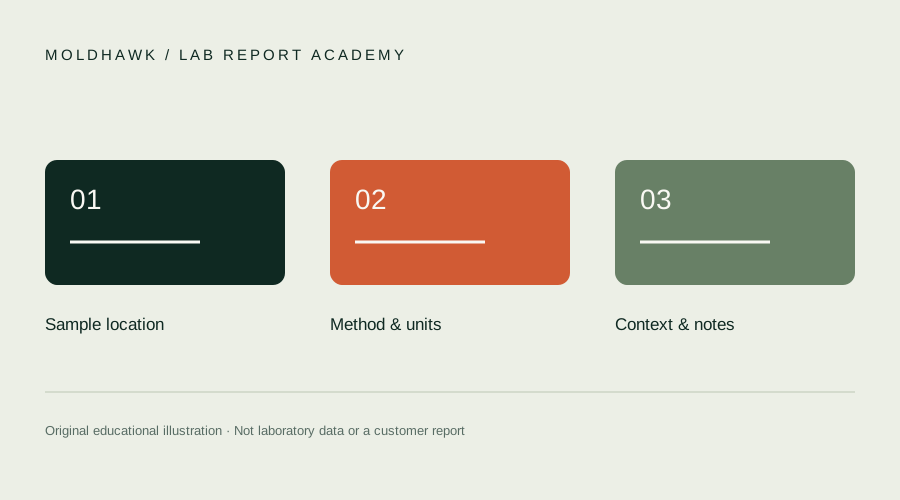
1. Match the result to the location
Start with the sample identifier and collection location. “Bedroom” and “Outdoors” must refer to the intended specimens. Check collection information against the inspection record before comparing numbers.
The date and collection conditions matter. A report is a record of the submitted specimens, not continuous monitoring of every room. Ask about any unclear location label rather than assuming it refers to the area you had in mind.
2. Keep raw counts and concentrations separate
A raw count is the number recorded by the analysis before any method-specific calculation. A reported spores-per-cubic-meter value expresses a concentration related to the sampled air volume and method. Use the units printed on your report.
In a deliberately simplified illustration, two differently collected specimens may show similar raw counts but different reported concentrations. That is why comparing raw counts without reviewing the volume and method can be misleading. The laboratory’s own calculation and notes control the actual report.
3. Compare patterns, not a single “score”
Review which categories appear and how the selected indoor and outdoor specimens relate. Consider moisture observations and collection conditions at the same time. Our interactive preview uses invented data to explain this reading process.
A larger indoor bar in that teaching example is a comparison, not a medical-risk category. NIOSH cautions that short-term spore counts do not translate into a health-risk measure.
4. Read the notes before deciding what comes next
Look for identification limits, background observations, collection issues and statements about the specimen. “Not detected” should be read within the method’s sensitivity and the sampled location, not as proof that a whole property contains no mold.
Use the report-review conversation to ask which finding matters to the original inspection question, what remains uncertain and what practical action follows. Keep the released laboratory PDF with the inspection summary rather than relying on an isolated screenshot of a number.
Your practical checklist
- Match sample IDs to collection locations.
- Check units and method notes before comparing values.
- Ask for property context and the remaining uncertainties.
Sources & scope
Scientific background and public guidance:
MoldHawk service details are described on our package pages. Published by MoldHawk for property-inspection education. Your property-specific scope and laboratory method control the actual inspection and report.
Turn the question into a defined scope.
Choose an inspection based on your property, concern areas and the decision you need to make.
See testing options →Book a professional assessment