Cladosporium, Aspergillus and Penicillium are common indoor mold names identified by CDC. In a laboratory report, a name needs to be read with the method, specimen location and property context; it is not a standalone diagnosis.
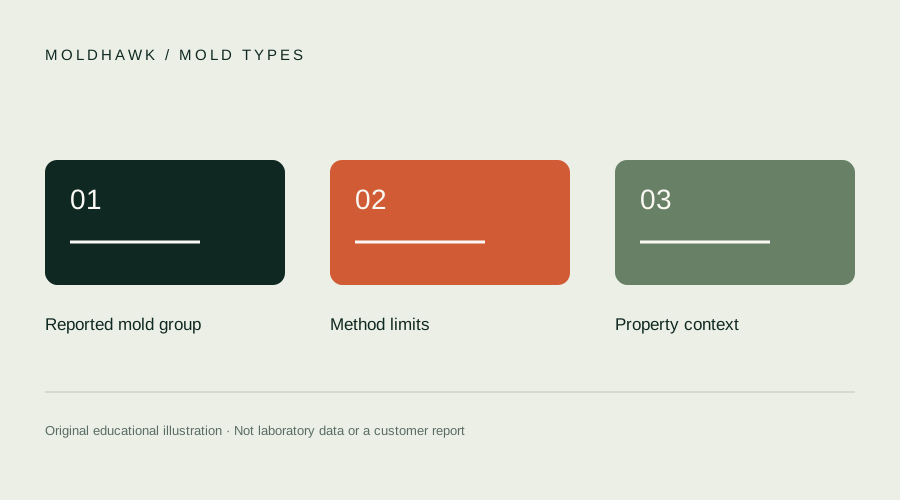
A name is not the whole finding
Read the reported category exactly as printed. A genus name, a group and a species-level identification are different levels of description. The analytical method limits how specific the result can be.
Our sample previews use mold-group labels to teach report reading. They are illustrations, not claims about a particular customer property or laboratory-issued findings.
Why group labels matter
Some microscopy reports group spores that cannot be reliably distinguished by that method. If your report lists an Aspergillus/Penicillium group, do not silently turn that into a confirmed species name.
Ask which identification level the laboratory method supports. A broader category can still be useful in context, but it does not answer a more specific question simply because a related organism appears in an online article.
Detection and toxins are different questions
A mold finding does not establish that a mycotoxin was produced or measured. CDC’s discussion of Stachybotrys also explains why a mold’s appearance and toxin-producing potential do not remove the need to address the underlying moisture concern.
Specialty analysis requires a specifically confirmed method and specimen. Standard mold identification should not be interpreted as a comprehensive toxin panel.
Return to the property context
Connect the name with the location, collection conditions and observed moisture history. Ask which finding matters to the original investigation question and what action follows.
CDC advises addressing mold and moisture rather than relying on species identification to decide whether a problem matters. If you have health concerns, discuss those with a healthcare professional; a property report is not a medical diagnosis.
During a report review, point to the exact row you want explained. Ask whether it is a grouped identification, which specimen it belongs to and whether the finding changes the recommended next step. That conversation is more useful than comparing the name with an unrelated photograph found online.
Your practical checklist
- Read grouped and species-level labels carefully.
- Ask what the method can identify.
- Keep mold detection separate from toxin analysis and medical interpretation.
Sources & scope
Scientific background and public guidance:
MoldHawk service details are described on our package pages. Published by MoldHawk for property-inspection education. Your property-specific scope and laboratory method control the actual inspection and report.
Turn the question into a defined scope.
Choose an inspection based on your property, concern areas and the decision you need to make.
See testing options →Book a professional assessment