A post-remediation assessment reviews the agreed conditions after cleanup. Its scope may include accessible observations, moisture context and justified samples. The criteria and site readiness must be confirmed before the visit.
Agree on the question before collection
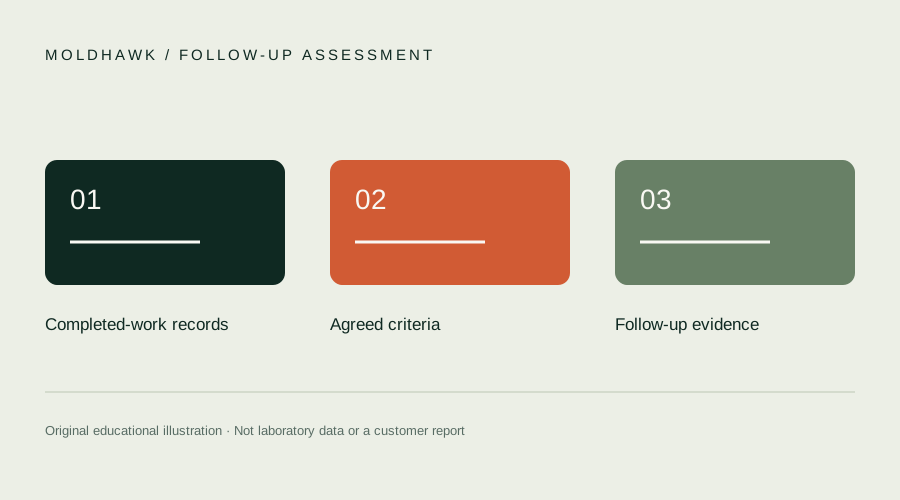
Start with the remediation scope and the work that was actually completed. Share relevant records and identify areas that were removed, repaired or left inaccessible. A follow-up assessment should not rely on assumptions about a contractor’s work.
Ask which observations and specimens will address the agreed question. A separate assessment is a new scope, not an automatic repetition of the original sample locations or package.
Consider the property conditions
EPA’s home guidance describes completion in terms of addressing moisture, removing growth and checking for recurrence. No single laboratory number replaces all of those considerations.
Confirm the practical conditions for the visit with the team. If work is unfinished or the area is not ready for the agreed assessment, discuss timing before collection rather than treating any appointment as suitable.
Understand the limits of sampling
Results relate to collected specimens and the selected methods. They do not certify all concealed materials or provide a medical clearance for every occupant.
Ask how any air or surface findings will be interpreted with observations and the original scope. Where evidence is incomplete or access is limited, that uncertainty should be visible in the record.
Plan the record you will keep
Keep the original investigation, cleanup documentation, repair records and follow-up findings together. This helps explain what question was addressed at each stage.
MoldHawk confirms post-remediation service by custom scope. Before booking, provide the relevant project details and discuss inspection criteria, access, reporting and any specialty work. Remediation itself is performed by an independent provider you select.
An effective handoff identifies the original question, the work completed and the decision the follow-up report will inform. If the cleanup contractor recommends particular criteria, share those before scheduling. The independent assessment can then be scoped around an explicit question rather than an undefined request for a passing result.
Your practical checklist
- Share the cleanup scope and completed-work records.
- Confirm site readiness and assessment criteria.
- Read observations and laboratory findings together.
Sources & scope
Scientific background and public guidance:
MoldHawk service details are described on our package pages. Published by MoldHawk for property-inspection education. Your property-specific scope and laboratory method control the actual inspection and report.
Turn the question into a defined scope.
Choose an inspection based on your property, concern areas and the decision you need to make.
See testing options →Book a professional assessment