Address the water source and wet materials promptly. Mold testing should not delay water-damage response. A later investigation can document accessible conditions and address questions about the affected areas.
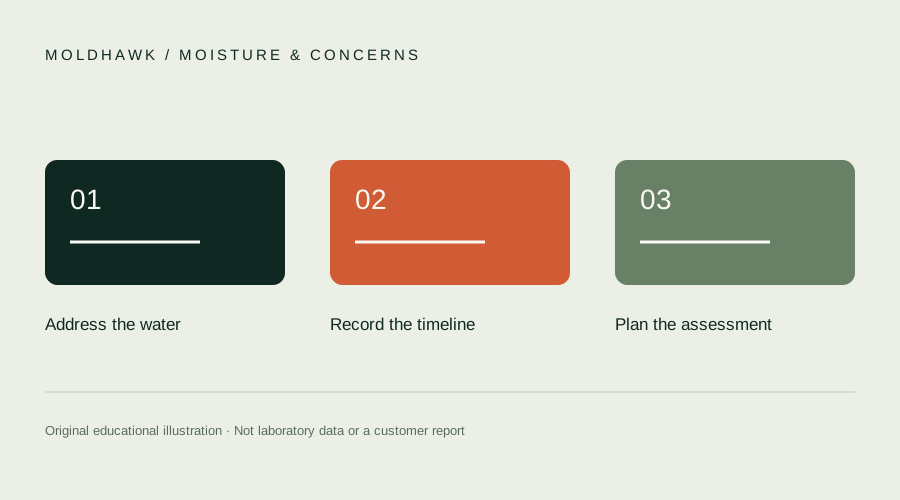
Deal with the water problem first
EPA’s water-damage guidance emphasizes a prompt response, often within a 24–48-hour window, while noting that timing is a guideline rather than a guarantee about growth. The material, extent of damage and water source affect the response.
Use an appropriate repair or restoration professional when needed. If the source may be contaminated, that requires particular care; a routine mold appointment is not a substitute for assessing the water-damage situation.
Keep a usable timeline
Record when the leak was noticed, where water traveled and what repairs or drying were performed. Keep invoices, photographs and material-removal records if they are available.
A concise timeline helps the technician understand the question at the time of inspection. “A leak happened” is less informative than knowing which rooms were affected and whether there was later recurrence.
Define what the inspection will cover
Discuss accessible materials, concern locations and any areas that were closed up after the repair. Tell the team if the work is still underway. An accessible inspection cannot retrospectively observe every concealed layer.
Sampling may be considered where it answers a specific question. The existence of a past leak does not itself determine a laboratory collection plan, and a laboratory number does not replace a moisture investigation.
Separate the different deliverables
The repair provider’s record, the inspection summary and any laboratory PDFs serve different purposes. Keep them together without assuming that one document certifies everything described in the others.
Before booking, confirm the service scope and timing. MoldHawk investigates and reports; repair and remediation remain separate services. If follow-up assessment is needed after cleanup, agree on its criteria and site readiness first.
A practical handoff might include three dated photographs, a repair invoice and a note identifying which wall was closed after drying. That record does not prove the current condition, but it gives the inspection a more precise starting question than a request to test the entire home without context.
Your practical checklist
- Respond to the water source promptly.
- Record the leak, repairs and affected areas.
- Ask which accessible questions the inspection can answer.
Sources & scope
Scientific background and public guidance:
MoldHawk service details are described on our package pages. Published by MoldHawk for property-inspection education. Your property-specific scope and laboratory method control the actual inspection and report.
Turn the question into a defined scope.
Choose an inspection based on your property, concern areas and the decision you need to make.
See testing options →Book a professional assessment