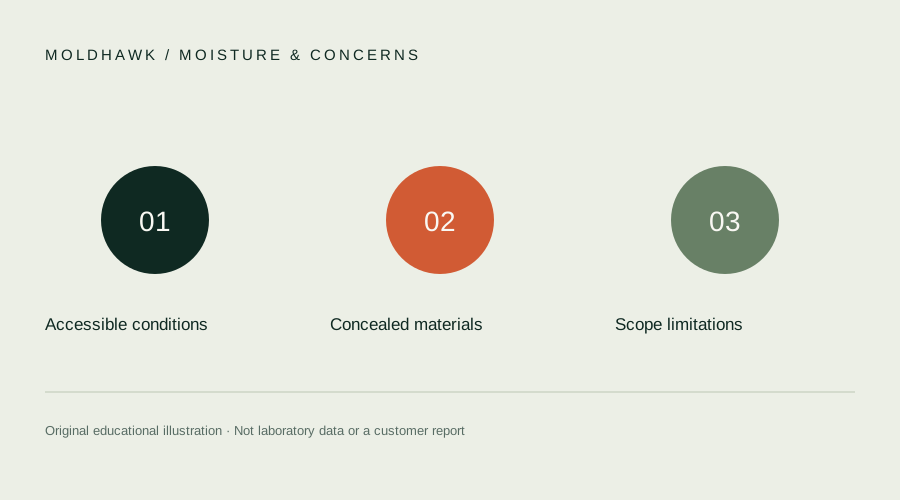
Mold can occur on concealed materials, but an accessible, non-destructive inspection cannot rule out every hidden condition. A concern about a wall cavity needs a defined investigation plan rather than a promise that one air sample sees through walls.
Distinguish a clue from a conclusion
A past leak, an odor or a recurring stain may help identify where to investigate. None of those clues alone establishes the mold type, its extent or the condition of every layer behind the finish.
Write down the history and location of the concern. If repairs were performed, share what was opened, removed or replaced. That context can be useful even when the area is no longer visible.
Understand the accessible scope
The inspection agreement should identify accessible areas and access restrictions. Explain whether a space is occupied, locked, covered by stored items or recently enclosed after repairs.
EPA’s home guide addresses concealed growth and warns that disturbing suspect areas can release spores. Opening a wall is a separate decision that requires appropriate permission, scope and professionals.
Ask what testing can establish
Ask how a proposed specimen will answer the question. A result describes a submitted sample within its method’s limits. It does not create visibility into materials that were never inspected or sampled.
If a finding is inconclusive, the report should say what remains uncertain. Further investigation may be a sensible outcome; it is different from guaranteeing either that a wall contains mold or that it is clear.
Plan the next decision
Before you book, identify what you need the investigation to help decide: documenting an accessible area, reviewing moisture clues or considering a separate scope for concealed conditions.
Keep inspection, laboratory, repair and cleanup records together. MoldHawk’s standard packages are non-destructive, and any additional scope must be confirmed before work proceeds.
Consider a planning example: a room has an old repaired leak and no accessible view of the cavity. Ask the team to distinguish current observations from the historical record. If a separate opening is proposed, confirm who authorizes it, who performs it and what question the additional work will answer.
Your practical checklist
- Share the leak and repair timeline.
- Confirm inaccessible areas in advance.
- Do not treat a specimen as a whole-wall guarantee.
Sources & scope
Scientific background and public guidance:
MoldHawk service details are described on our package pages. Published by MoldHawk for property-inspection education. Your property-specific scope and laboratory method control the actual inspection and report.
Turn the question into a defined scope.
Choose an inspection based on your property, concern areas and the decision you need to make.
See testing options →Book a professional assessment